
“In valuation practice two generic methods of application can be distinguished: the direct and the indirect; within them there is a wide range of nuances that define different procedures to be applied in operational technique” (Dante Guerrero, 1994).
GRAPHIC OUTLINE OF THE CSV VALUATION MODEL
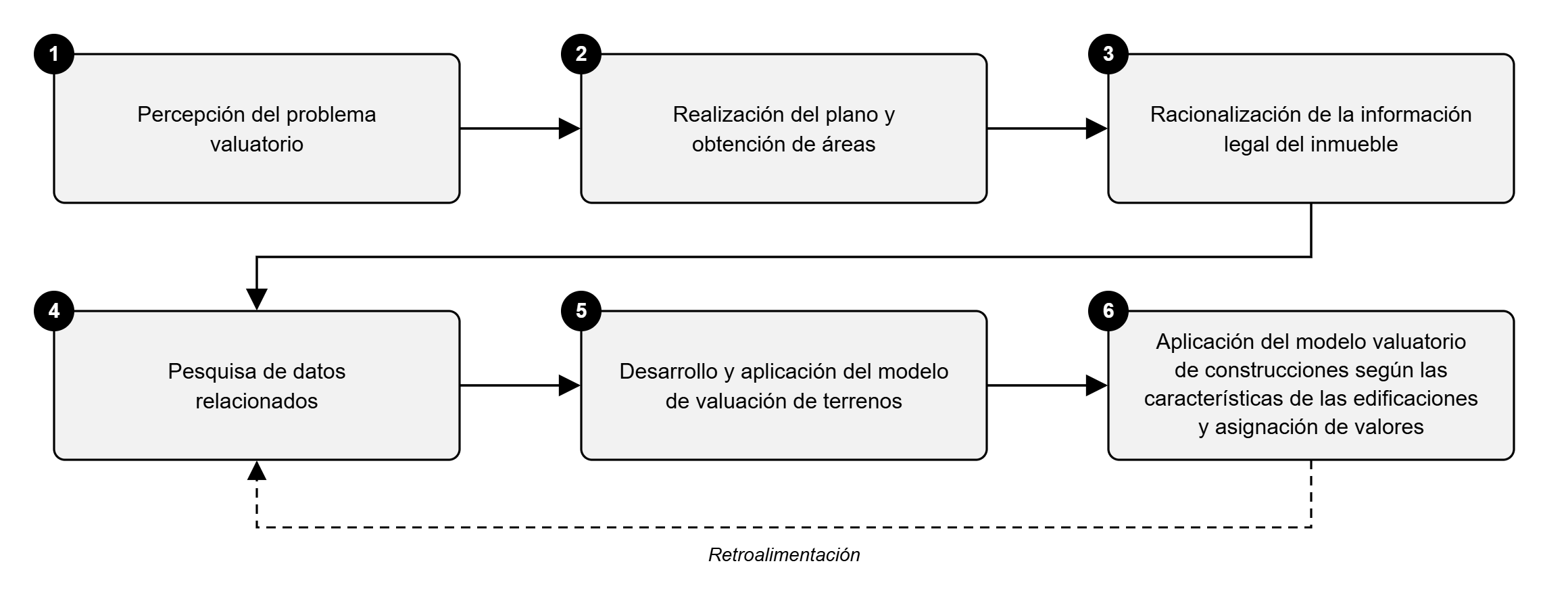
The methodology followed for each assignment is generally the “direct comparison method”, cross-checked against indirect methods as a control, following a sequence of steps summarised below. However, the valuation method applied is flexible and may be complemented by others such as the replacement cost method, the income capitalisation method or the residual method, and may vary depending on the type of asset being valued and the market information available as evidence.
The work includes the following steps:
- Fieldwork with a physical inspection of the asset (property, industrial complex, machinery, vehicle, etc.) to collect data and verify the documentation provided.
- Market research to obtain evidence of actual sales and offers of similar or sufficiently comparable real estate and movable assets, and comparison with our up-to-date database.
- Adjustment (homogenisation) of evidence for the valuation analysis and identification of factors that increase or decrease the value of the asset.
- Contact with suppliers of new and used machinery and equipment in foreign markets in the case of specialised machinery.
- Analysis and assessment of the data obtained in order to assign reliable values in line with market reality.
- Analysis of the economic environment of the sector to which the asset belongs, based on the documentation provided by the applicant and on economic parameters obtained from reliable sources.
- Detailed review of the work carried out (form and substance).
- Verification of the clarity of the observations included in the reports, especially where there are risk considerations for the financial institution.
- Constant, periodic feedback with the institution’s loan officers on actual asset transactions and on the quality of the work submitted.
- In addition, to safeguard the quality of our reports, we continuously carry out:
- a. Ongoing collection of market information: asking prices of land, construction costs from specialised construction publications (verified in the local market), public property sale offers and auctions.
- b. Updating of price references in the “Zoned map of asking-price ranges” and in the available database (with data from 1990 to date).
- c. Construction monitoring to verify building costs.
- d. Constant attention to new real estate regulations issued by government and municipal bodies.
- e. Individual review of each case to identify irregularities, based on accumulated experience and knowledge of municipal regulations.
Each report is delivered as soon as possible (taking into account the scope and complexity of each assignment) after the physical inspection in the case of real estate; this requires all the documentation needed to carry out the inspection. For machinery and industrial complexes, the delivery time depends on the complexity and scope of the assignment, the number of items and the size of the company, and is indicated at the time of the physical inspection.